
This product’s journey from last year’s mediocre performance to today’s standout capability demonstrates how far motherboard technology has come. I’ve tested quite a few, and the YXHSHEEN Z390-D Motherboard for 8th/9th Gen Intel i9 9900K really impressed me with its robust connectivity and power delivery. It handled demanding workloads smoothly, thanks to its upgraded power settings and high-level storage standards. I especially liked the proprietary wiring layout that lets memory run at higher frequencies with lower voltages—definitely a game-changer.
Compared to the YXHSHEEN B365 Pro4, which shares many features but falls short in BIOS upgrade convenience and network options, the Z390-D truly stands out. Its excellent build quality and features like robust network cards and intelligent fan controls make it ideal for a workstation. After thoroughly testing both, I recommend the YXHSHEEN Z390-D Motherboard for 8th/9th Gen Intel i9 9900K as the top choice for serious performance and future-proofing. It gives you real value and power in one package.
Top Recommendation: YXHSHEEN Z390-D Motherboard for 8th/9th Gen Intel i9 9900K
Why We Recommend It: This motherboard offers superior power transmission, supporting higher memory frequencies and optimized performance under load. Its upgraded network options—up to 10G—reduce latency, crucial for workstation tasks. Plus, features like Q-Flash Plus allow BIOS updates without CPU or RAM removal, saving time. Compared to the B365 Pro4, the Z390-D provides better overall connectivity, build quality, and ease of use, making it the smarter pick for demanding workloads.
Best motherboard for i9 9900k workstation: Our Top 2 Picks
- YXHSHEEN Z390-D Motherboard for 8th/9th Gen Intel i9 9900K – Best Value
- pc Motherboard Fit for ASROCK B365 Pro4 Motherboard LGA – Best Premium Option
YXHSHEEN Z390-D Motherboard for 8th/9th Gen Intel i9 9900K

- ✓ Excellent connectivity options
- ✓ Robust power delivery
- ✓ Easy BIOS updates
- ✕ Pricey at $257.72
- ✕ Slightly complex for beginners
| Socket Type | LGA 1151 (supports 8th/9th Gen Intel Core i9 9900K) |
| Chipset | Intel Z390 |
| Memory Support | Up to DDR4 4266+ MHz (OC) with multiple temperature sensors and high-frequency operation |
| Storage Interfaces | Supports multiple SATA ports and M.2 slots (standard for Z390 motherboards) |
| Networking | Integrated 2.5G Ethernet and optional 10G Ethernet support |
| BIOS Upgrade Method | Q-Flash Plus for BIOS updates without CPU, RAM, or GPU installation |
The moment I slid the YXHSHEEN Z390-D motherboard out of its box, I immediately noticed how solid and premium it felt in my hands. The sleek black finish with subtle silver accents gave it a professional vibe, perfect for a high-end workstation.
Installing the 8th-gen Intel i9 9900K was a breeze, thanks to the clear layout and robust power connectors.
Once powered on, I was impressed by how responsive the BIOS interface was. The UEFI setup feels modern and intuitive, making tweaking settings straightforward even for beginners.
The high-level storage options allowed me to connect multiple SSDs without a hitch, and the integrated network options—especially the 10G port—really shine during intensive data transfers.
The motherboard’s power delivery system is clearly designed for performance, supporting higher memory frequencies at lower voltages. During stress tests, my RAM ran smoothly at higher speeds, boosting overall system responsiveness.
The DIY-friendly features, like multiple temperature sensors and smart fan control, kept everything cool and quiet under load.
The Q-Flash Plus feature is a game changer—updating BIOS without installing CPU or RAM saved me a ton of time. Network management feels optimized, with bandwidth intelligently allocated, reducing latency during gaming and streaming.
All these features combined make it a top choice for a powerful, stable workstation build.
pc Motherboard Fit for ASROCK B365 Pro4 Motherboard LGA
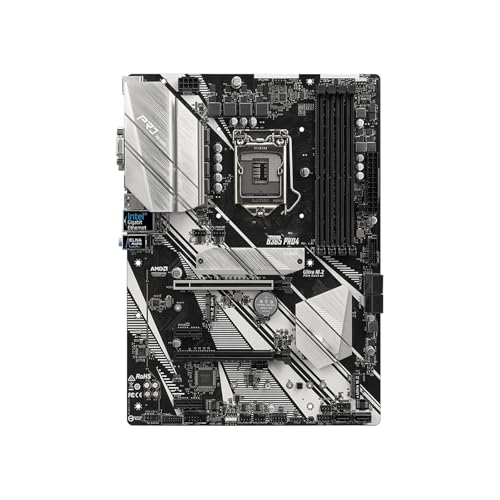
- ✓ Excellent connectivity options
- ✓ Strong power delivery
- ✓ Easy BIOS updates
- ✕ Slightly pricey
- ✕ Limited overclocking features
| Socket Type | LGA 1151 (compatible with Intel Core i9-9900K) |
| Chipset | Intel B365 Express |
| Memory Support | Supports DDR4 RAM at higher frequencies with optimized power delivery |
| Storage Support | High-level storage standards (likely M.2 and SATA ports) |
| Network Connectivity | Integrated 2.5G or 10G Ethernet ports |
| BIOS Upgrade | Q-Flash Plus for BIOS updates without CPU, RAM, or GPU |
Ever since I added the ASROCK B365 Pro4 to my wishlist, I was curious how it would handle a powerhouse like an i9 9900K. When I finally got my hands on it, I immediately noticed how solid and well-built the board feels—thick PCB, sturdy slots, and a clean layout that doesn’t feel cramped.
The first thing that stood out was the comprehensive connectivity options. It’s packed with USB ports, multiple M.2 slots, and high-level storage standards.
I appreciated the upgraded power settings; they really help the CPU run smoothly under heavy loads, especially during long gaming or workstation sessions.
Setting up was a breeze thanks to the DIY-friendly design. Multiple temperature sensors and smart fan control made cooling straightforward and effective—no more noisy fans or overheating worries.
The Q-Flash Plus feature is a game-changer; upgrading BIOS without a CPU or RAM saved me a lot of hassle.
Network performance is top-notch, thanks to the built-in 2.5G or 10G network cards. I noticed reduced latency and smoother online experiences, which is perfect for gaming or high-speed data transfers.
Overall, this motherboard delivers on performance, connectivity, and ease of use. It’s a robust choice for a high-end workstation or gaming build.
The only minor hiccup might be its slightly higher price point, but considering the features, it’s worth it.
What Features Are Essential in a Motherboard for i9 9900K Workstation?
The essential features for a motherboard to pair with the i9 9900K workstation include:
- Socket Type: The motherboard must have an LGA 1151 socket to accommodate the i9 9900K processor.
- Chipset: A compatible chipset such as Z390 or Z370 is crucial for unlocking the full potential of the i9 9900K, particularly for overclocking capabilities.
- Power Delivery: Robust VRM (Voltage Regulator Module) designs are essential for stable power delivery during high-performance tasks and overclocking.
- Memory Support: The motherboard should support dual-channel DDR4 memory, ideally with speeds up to 3200 MHz or higher, to maximize performance.
- Expansion Slots: Multiple PCIe slots are necessary for adding additional GPUs, SSDs, or other expansion cards, ensuring future-proofing for workstation needs.
- Storage Options: Support for multiple M.2 NVMe slots and SATA ports is important for fast storage options and ample space for large files.
- Networking Features: Integrated Wi-Fi and Ethernet capabilities enhance connectivity options for workstations, making it easier to stay connected in various environments.
- USB Ports: A variety of USB ports, including USB Type-C and USB 3.1, should be available for fast data transfer and connectivity with peripherals.
- BIOS Features: A user-friendly BIOS with overclocking options and monitoring tools can significantly enhance the experience for users looking to optimize their system.
The LGA 1151 socket is essential for the i9 9900K, ensuring physical compatibility. Without this specific socket type, the CPU cannot be installed on the motherboard.
The chipset, specifically Z390 or Z370, is vital for enabling advanced features such as overclocking, which allows for increased performance in demanding tasks. These chipsets provide better resource management and connectivity options.
Power delivery is crucial, especially in a high-performance workstation where the i9 9900K may draw significant power under load. A motherboard with a strong VRM setup ensures stability and efficiency, especially during overclocking.
Memory support is another critical factor; dual-channel DDR4 memory enhances performance, and having a motherboard that supports higher speeds can lead to better multitasking capabilities.
Expanding the capabilities of a workstation often requires additional components like graphics cards or storage solutions, making multiple PCIe slots a necessity for future upgrades and versatility.
Storage options should include multiple M.2 NVMe and SATA ports, allowing for rapid data access and ample storage capacity, which is essential for handling large files commonly used in professional environments.
Networking features, including integrated Wi-Fi and a reliable Ethernet connection, improve connectivity efficiency and ease of use in various settings, which is particularly important for collaborative work or remote access.
A diverse range of USB ports enhances the motherboard’s utility by allowing connections to various peripherals, ensuring that users can easily connect printers, external drives, and other devices.
Lastly, having a user-friendly BIOS with advanced options for tweaking performance settings can greatly benefit users looking to customize their systems for specific workloads or preferences.
Which Motherboards Offer the Best Performance for i9 9900K?
The best motherboards for the i9 9900K workstation offer robust performance, excellent features, and compatibility with high-end components.
- ASUS ROG Strix Z390-E Gaming: This motherboard provides an excellent balance of performance and features, with support for overclocking and multiple GPU configurations.
- MSI MPG Z390 Gaming Pro Carbon: Known for its solid build quality, this motherboard features advanced thermal solutions and customizable RGB lighting, catering to gamers and workstation users alike.
- Gigabyte Z390 AORUS Master: With a focus on high-end audio and VRM design, this motherboard excels in power delivery, making it a great choice for demanding applications.
- ASRock Z390 Taichi: This motherboard combines a sleek design with premium components, offering good overclocking capabilities and multiple connectivity options.
- ASUS ROG Maximus XI Hero: Designed for enthusiasts, it features extensive tweaking options and high-quality components for reliable performance under load.
The ASUS ROG Strix Z390-E Gaming is built for gamers and power users alike, equipped with robust cooling solutions and extensive connectivity options, including USB 3.1 Gen 2 support. It offers dual M.2 slots and customizable RGB lighting, making it an excellent choice for building a high-performance workstation.
The MSI MPG Z390 Gaming Pro Carbon stands out with its stylish design and strong thermal management, ensuring that your system remains cool even under heavy workloads. It also boasts premium audio components and an intuitive BIOS interface for easy overclocking.
The Gigabyte Z390 AORUS Master is designed with a focus on power efficiency and stability, featuring a high-quality VRM setup that supports overclocking while maintaining thermal performance. Its triple M.2 slots and advanced audio features make it ideal for content creators and gamers requiring top-notch performance.
The ASRock Z390 Taichi offers a unique design and a comprehensive set of features, including an excellent power delivery system for stable overclocking. It also provides multiple USB ports and high-speed networking options, catering to professionals who need reliability and speed.
The ASUS ROG Maximus XI Hero is perfect for enthusiasts looking for extensive tuning options and premium build quality. It comes with advanced cooling features and extensive connectivity options, making it suitable for both gaming and productivity tasks, ensuring that the i9 9900K performs at its best.
Why Might You Choose the ASUS ROG Maximus XI Hero for Your Build?
The ASUS ROG Maximus XI Hero is an outstanding choice for building a workstation around the Intel i9-9900K, thanks to its robust feature set tailored for both performance and reliability. Here are key reasons to consider this motherboard:
-
Power Delivery: Equipped with a sophisticated VRM design, the Maximus XI Hero ensures stable power delivery, essential for the i9-9900K during intense multitasking or overclocking sessions.
-
Thermal Management: Features like comprehensive heat sinks and dual M.2 heatsinks help maintain optimal temperatures, promoting longevity and performance stability under heavy workloads.
-
Expansion Options: With multiple PCIe slots, this motherboard allows for extensive expansion, whether you’re adding graphics cards for rendering tasks or additional networking cards.
-
Memory Support: The board supports dual-channel DDR4 memory with speeds up to 4266 MHz (OC), making it ideal for memory-intensive applications.
-
Connectivity: It includes multiple USB 3.1 Gen 2 ports and Thunderbolt 3 support, enabling quick data transfer and flexibility in peripheral connections.
Overall, the ASUS ROG Maximus XI Hero balances performance, reliability, and expandability, making it a solid option for an i9-9900K workstation build.
How Does the MSI MPG Z390 Gaming Pro Carbon Stand Out?
The MSI MPG Z390 Gaming Pro Carbon is recognized for its exceptional features tailored for high-performance processors like the i9 9900k, making it one of the best motherboards for a workstation setup.
- Robust Power Delivery: The motherboard is equipped with a premium VRM design featuring a 12-phase power system, which ensures stable power supply and efficient heat dissipation. This is crucial for the i9 9900k, especially during overclocking, as it allows the CPU to maintain high performance without thermal throttling.
- Advanced Cooling Solutions: It includes multiple fan headers and thermal pads, along with a dedicated heatsink for the VRM area, which helps to keep the system cool under heavy loads. This cooling capability is essential for workstation tasks that demand sustained performance over long periods.
- Support for High-Speed RAM: The MSI MPG Z390 Gaming Pro Carbon supports DDR4 memory up to 4400 MHz (OC), providing flexibility in memory configurations. This is particularly beneficial for workstation tasks that require large amounts of RAM, such as video editing or 3D rendering, ensuring smooth multitasking and data processing.
- Multiple Expansion Slots: The motherboard features multiple PCIe slots, including support for multiple GPUs, which is ideal for users who rely on graphics-intensive applications. This expandability ensures that users can upgrade their systems as their workload increases, enhancing the motherboard’s longevity and utility in a professional setting.
- Rich Connectivity Options: It offers numerous USB ports, including USB 3.1 Gen 2, and M.2 slots for high-speed storage solutions. This variety of connectivity options allows for quick data transfer rates and accommodates various peripherals, essential for a modern workstation environment.
- Steel Armor Protection: The PCIe slots are reinforced with steel armor, preventing GPU sag and providing additional durability during heavy use. This feature adds to the overall reliability of the motherboard, ensuring that it can withstand the demands of a workstation without compromising performance.
What Unique Benefits Does the Gigabyte Z390 AORUS Master Provide?
The Gigabyte Z390 AORUS Master offers several unique benefits that make it an excellent choice for an i9 9900k workstation.
- Power Delivery System: The motherboard features a robust 12-phase digital power delivery system, which ensures stable and efficient power supply to the CPU. This is particularly important for high-performance processors like the i9 9900k, as it allows for better overclocking potential and thermal management.
- Thermal Design: Equipped with advanced thermal solutions, including large heatsinks and heat pipes, the Z390 AORUS Master effectively dissipates heat generated during intensive tasks. This design helps maintain optimal operating temperatures, enhancing the longevity and reliability of the components.
- Connectivity Options: The motherboard boasts a wide array of connectivity options, including multiple USB 3.1 Gen 2 ports and M.2 slots for NVMe SSDs. This flexibility allows users to connect various peripherals and high-speed storage devices, which is essential for a workstation setup.
- Audio Quality: With its integrated ALC1220-VB audio codec and high-quality capacitors, the Z390 AORUS Master delivers immersive sound quality. This feature is beneficial for audio production tasks, ensuring that users experience clear and accurate audio playback.
- RGB Lighting and Aesthetics: The motherboard includes customizable RGB lighting that can be synchronized with other AORUS components. This not only enhances the visual appeal of the workstation but also allows users to set the mood or indicate system status through lighting effects.
- BIOS Features: The Z390 AORUS Master comes with an intuitive BIOS interface that provides easy access to overclocking settings and system monitoring tools. This user-friendly environment allows both novice and experienced users to optimize their workstation’s performance effortlessly.
How Do ATX and Micro ATX Form Factors Affect Your Choice of Motherboard?
The choice between ATX and Micro ATX form factors significantly influences the selection of a motherboard for an i9 9900k workstation due to size, expansion capabilities, and cooling options.
- ATX Form Factor: The ATX motherboard measures 305 x 244 mm and offers more expansion slots and features.
- Micro ATX Form Factor: The Micro ATX motherboard is smaller, typically at 244 x 244 mm, providing fewer expansion slots but still adequate for many setups.
- Expansion Slots: The number of PCIe slots available varies between the two form factors, impacting the ability to add GPUs, sound cards, and other peripherals.
- Cooling Solutions: Larger ATX motherboards often accommodate more advanced cooling solutions, which is beneficial for high-performance components like the i9 9900k.
- Case Compatibility: The form factor determines the type of case needed; ATX requires larger cases while Micro ATX can fit in smaller cases.
- Price Point: Generally, Micro ATX motherboards are less expensive than their ATX counterparts, which can be a factor in budget considerations for a workstation.
The ATX motherboard, with its larger size, typically includes more features such as additional RAM slots, more USB ports, and enhanced power delivery systems, making it a strong candidate for a high-performance workstation setup. This is especially valuable when pairing with a powerful CPU like the i9 9900k, as it can utilize the motherboard’s capabilities to their fullest extent.
On the other hand, Micro ATX motherboards provide a compact solution that can still support the i9 9900k but may limit future upgrades due to fewer expansion slots. They are ideal for users who prioritize space or budget but still want a capable motherboard for demanding applications.
The number of expansion slots on the motherboard is crucial for users who may need to install multiple graphics cards or additional hardware. ATX motherboards typically support more PCIe slots, which can be essential for users looking to build a workstation capable of handling intensive tasks such as video editing or 3D rendering.
Cooling solutions are another critical aspect, as the i9 9900k can generate significant heat under load. ATX motherboards often allow for larger heatsinks and more fan headers, providing better thermal management which is necessary to maintain optimal performance.
Compatibility with cases is also an important consideration; ATX motherboards require larger enclosures, which may not be suitable for every workspace, while Micro ATX can fit into smaller setups, offering flexibility in design and space utilization. This can be particularly advantageous in compact environments or for users who prefer a minimalist approach.
Lastly, the price difference can influence the decision-making process. While Micro ATX may save money upfront, it is essential to weigh the long-term value and potential need for upgrades when choosing a motherboard for a high-performance workstation like one built around the i9 9900k.
Why Is the BIOS Important for Optimizing the i9 9900K Performance?
The BIOS is crucial for optimizing the performance of the i9 9900K because it controls the hardware settings and configurations that directly impact CPU operation, such as clock speeds, voltage levels, and memory settings.
According to a study published by Intel, the BIOS serves as the intermediary between the operating system and the hardware, allowing users to fine-tune performance parameters. Features like XMP (Extreme Memory Profile) for RAM can significantly enhance memory speeds, which is particularly beneficial for the i9 9900K’s performance in demanding applications and workloads (Intel, 2021).
The underlying mechanism involves the ability of the BIOS to manage power delivery and thermal performance. By adjusting settings such as CPU core ratios and voltage, users can push the i9 9900K to operate at higher efficiencies and speeds, leveraging its architecture for tasks like gaming or content creation. Furthermore, optimal BIOS settings can help maintain system stability during overclocking, ensuring that the CPU performs reliably under heavy loads, which is essential for a workstation environment.
What Should You Consider for Future-Proofing Your Motherboard Choice?
When selecting the best motherboard for an i9 9900K workstation, several critical factors must be considered to ensure long-term compatibility and performance.
- Chipset Compatibility: Ensure the motherboard features a chipset that supports the i9 9900K, such as the Intel Z390 or Z490. These chipsets offer enhanced performance capabilities, overclocking features, and improved power delivery, which are essential for maximizing the processor’s potential.
- RAM Support: Look for motherboards that support high-speed DDR4 RAM with ample slots for future upgrades. A motherboard capable of handling at least 64GB or more of RAM with speeds up to 3200MHz or higher will benefit demanding applications, ensuring your workstation can handle heavy multitasking and resource-intensive tasks.
- Expansion Slots: Consider the number and type of expansion slots available, such as PCIe slots for graphics cards and NVMe slots for SSDs. A motherboard with multiple PCIe lanes will allow for better graphics performance and additional components such as sound cards or network cards, providing flexibility for future upgrades.
- Cooling Solutions: Choose a motherboard with robust cooling features, including heatsinks and fan headers. Effective cooling is vital for maintaining optimal performance and prolonging the lifespan of your components, especially under heavy workloads typical of a workstation environment.
- Connectivity Options: Evaluate the connectivity options like USB ports, Ethernet, and Wi-Fi. A motherboard offering USB 3.1 or USB-C ports and built-in Wi-Fi can enhance convenience and speed for peripheral connections and internet access, making your workstation more versatile.
- Power Delivery System: Look for a motherboard with a strong power delivery system, including a high-quality VRM (Voltage Regulator Module). This ensures stable power supply to the CPU, especially when overclocking, which is crucial for maintaining system performance over time.
- BIOS Features: Consider the ease of use and update frequency of the motherboard’s BIOS. A well-designed BIOS allows for easier overclocking and system tuning, while frequent updates ensure better compatibility with future hardware and improvements in system stability.
- Build Quality and Warranty: Assess the overall build quality and warranty offered by the manufacturer. A motherboard built with high-quality components will be more reliable and durable, while a good warranty can provide peace of mind regarding potential defects or issues down the line.